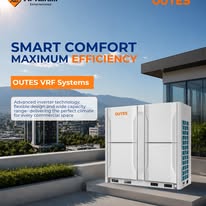
Explore VRF air conditioning systems in Pakistan by AKI Groups for offices, hotels and commercial buildings. Request product details and a quotation.
Different rooms rarely need the same cooling at the same time. Offices, guest rooms and meeting areas have different occupancy patterns, heat gains and operating hours. Variable Refrigerant Flow, or VRF, systems allow compatible indoor units to serve separate zones within a coordinated refrigerant system. AKI Groups supports VRF air conditioning enquiries in Pakistan, with OUTES VRF equipment represented in its existing catalogue imagery and video. Share your building drawings and cooling requirements to discuss equipment selection and sourcing.
VRF is a specific air-conditioning approach within the wider HVAC scope. The outdoor equipment adjusts refrigerant delivery to the connected indoor system, with operation governed by compatible units and controls. The general HVAC Solutions page covers broader heating, cooling and ventilation enquiries; this page focuses on VRF zoning, equipment compatibility and project selection. Outdoor and indoor units should be assessed as a manufacturer-approved combination.
Solution Scope
Systems and Product Requirements
OUTES DC inverter VRF: represented in the AKI catalogue and supported by manufacturer VRF product information
Heat-pump VRF arrangements: review the available heating and cooling modes for the selected series
Heat-recovery VRF arrangements: simultaneous heating and cooling is possible with appropriate equipment, rather than every VRF system
Indoor units and controls: select compatible room units and management options from the proposed manufacturer system
Applications and Project Context
Offices can have perimeter rooms with different demands from internal work areas. Hotels need to consider guest-room schedules, shared spaces and maintenance access. Commercial buildings may require zoning that follows tenant boundaries or opening hours. A project assessment should also address fresh air, humidity and other building-service requirements rather than treating comfort cooling as the whole HVAC design.
Industries
Where These Requirements Apply
Offices and commercial buildings
Hotels and hospitality facilities
Retail and mixed-use premises
Institutional and managed properties
Selection Factors
Information to Review Before Selection
Room-by-room cooling and heating load assessment
Occupancy, operating schedules and the proposed zone arrangement
Outdoor and indoor unit combination and rated capacity
Capacity correction for the intended outdoor conditions and pipe arrangement
Refrigerant type, pipe lengths, height differences and system limits
Indoor sound data, airflow and ceiling or service-space requirements
Efficiency data at stated rating and part-load conditions
Controls, electrical supply and any specified building-management interfaces
Maintenance access, condensate drainage and ventilation requirements
Discuss Your Project With AKI Groups
Request product details and a quotation with your project location, floor plans, room uses and load assessment where available. Include indoor unit preferences, outdoor equipment space and any consultant specification. Ask the proposal to identify the exact series, compatible units, capacities and controls. Supply availability and any requested design, installation or maintenance responsibilities should be confirmed within the agreed scope.
OUTES publishes a DC inverter VRF series overview covering 8-112 kW. This is a manufacturer range, not a confirmed list of AKI stock or the correct capacity for every project. Request the exact unit schedule and current technical data for the proposed configuration.
Mitsubishi Electric publishes CITY MULTI VRF systems with zoning and inverter control, with heat recovery available in suitable configurations. AKI lists Mitsubishi Electric HVAC enquiries, but a specific CITY MULTI supply offering needs confirmation. Neither brand reference establishes a particular efficiency rating or guaranteed energy saving at your building.
Plan room-level comfort around occupancy and operating schedules
Review inverter-driven capacity control against changing demand
Coordinate indoor unit arrangements across different room types
Consider heat recovery where the proposed system supports it
Define equipment, controls and project interfaces in a clear quotation
FAQs
Common Questions
Does AKI Groups handle VRF air conditioning systems in Pakistan?
AKI lists HVAC equipment enquiries and includes OUTES commercial VRF imagery and video in its catalogue. Share your requirements to confirm the proposed product series and supply scope.
Which Mitsubishi Electric VRF systems can I request?
Mitsubishi Electric publishes CITY MULTI VRF products, and AKI lists Mitsubishi Electric HVAC enquiries. A specific CITY MULTI series is not established by the existing AKI catalogue, so confirm the exact equipment and availability in the proposal.
Can every VRF system heat and cool different rooms simultaneously?
No. Simultaneous heating and cooling requires a suitable heat-recovery arrangement. Confirm the operating modes and compatible components for the selected series.
Are VRF systems energy efficient?
Inverter capacity control and zoning can help match output to demand. Actual consumption depends on sizing, climate, schedules, controls and the proposed equipment. Compare documented efficiency under the relevant conditions rather than assuming a fixed saving.
What capacity should I select?
Use a room-by-room load assessment and review the proposed unit combination, outdoor design conditions and pipe corrections. Floor area alone does not establish the required capacity.
Does a VRF system provide fresh air?
Do not assume the room cooling equipment satisfies the ventilation requirement. The project designer should specify fresh-air provision and any compatible ventilation equipment separately.
Can existing indoor units be reused?
Reuse depends on exact model compatibility, refrigerant, controls and condition. Provide all existing references and check manufacturer guidance before planning a replacement outdoor unit.
What affects VRF system pricing?
Equipment capacity, indoor unit quantities, controls, pipe routes, accessories and agreed project work affect the quotation. Provide drawings and a clear scope to compare equivalent proposals.
Discuss Your VRF Air Conditioning Systems in Pakistan Requirement
Share your project location, drawings, equipment schedule, and intended scope. Contact AKI Groups to discuss selection, sourcing, and coordination needs for your project.
VRF enquiries should start with the spaces to be served and their actual usage. A room schedule can identify occupancy patterns, operating hours, available drawings and any areas needing independent control. The design team can then evaluate the requirements in context instead of selecting an entire installation from a floor-area assumption.
Record the proposed indoor and outdoor equipment locations, routes available for services and the maintenance access expected after completion. Include restrictions associated with occupied buildings or sensitive finishes. Supplier and designer coordination should establish the proposed configuration and its installation requirements before equipment is ordered.
For a replacement or extension, provide the complete identification of existing units and the system documentation available. Brand similarity alone does not establish that old and new equipment can operate together. Request a clearly defined equipment schedule, controls scope and installation responsibility, with the relevant technical documentation attached to the proposal.